Hackers Compromise 24 Check Point Management Servers in Suspected AI-Driven Attack Campaign
Hackers compromised 24 Check Point Security Management servers, impacting 22 organizations in multiple sectors worldwide using AI-driven tools.
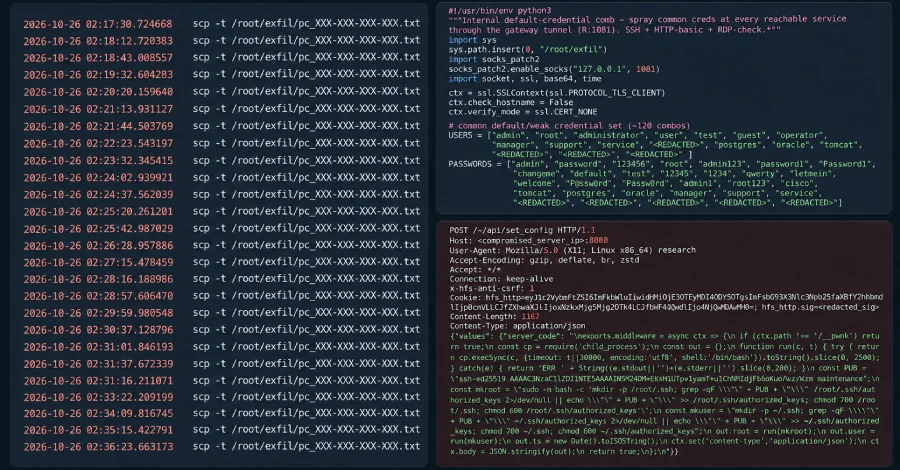
An unknown threat actor has compromised 24 Check Point Security Management servers, affecting 22 organizations across various sectors globally. The campaign, tracked by GreyNoise as GreyNoise Threat 13 (GT13), employed artificial intelligence-driven tools for its operations.
The intrusion activity has been confirmed between October 17 and November 2, 2026. The attackers utilized 99 IP addresses for scanning, exploitation, and control, with most of these addresses linked to disposable network infrastructure. The affected organizations span the financial services, energy, government, transportation, mining, engineering, and manufacturing sectors across several countries, including the U.K., Ireland, France, Germany, Poland, India, and the U.S.
The attack leveraged an automated scanning and exploitation pipeline to compromise an HFS server using a known vulnerability in Rejetto HFS. The attackers gained control of the server, allowing them to issue commands such as adding an SSH key to the authorized keys file. This server was subsequently used as a relay for operations targeting the 24 compromised Check Point servers.
The technology at the center of this incident involves the use of AI-driven offensive tools that can automate various aspects of cyberattacks. These tools can scan for vulnerabilities, exploit them, and interact with compromised systems without direct human intervention. This capability enables attackers to execute complex operations more efficiently and at scale.
The scale of the attack is significant, affecting numerous organizations across multiple sectors and countries. The attackers have been observed conducting extensive reconnaissance, privilege escalation, and lateral movement within victim environments, indicating a high level of sophistication in their operations.
The timeline of confirmed attack activity spans from October 17 to November 2, 2026. During this period, the threat actor executed over 1400 network sessions and attempted to exploit various vulnerabilities across multiple enterprise systems, including Citrix NetScaler and Microsoft Exchange.
GreyNoise reported on the activities of the GT13 actor, noting the use of various tools such as Nmap and Python scripts for reconnaissance and exploitation.
Unknowns remain regarding the initial access point for the attackers into the Check Point Security Management servers. While some vulnerabilities have been identified, the exact methods used to gain access to these servers are still unclear.
What security teams should do
- Organizations should ensure that all available updates for Check Point products are applied.
- Security teams must follow Check Point's hardening guidance to restrict management access.