Xalgorix: Open-source AI penetration testing tool
Xalgorix is an open-source AI penetration testing tool designed to minimize false positives in vulnerability reporting.
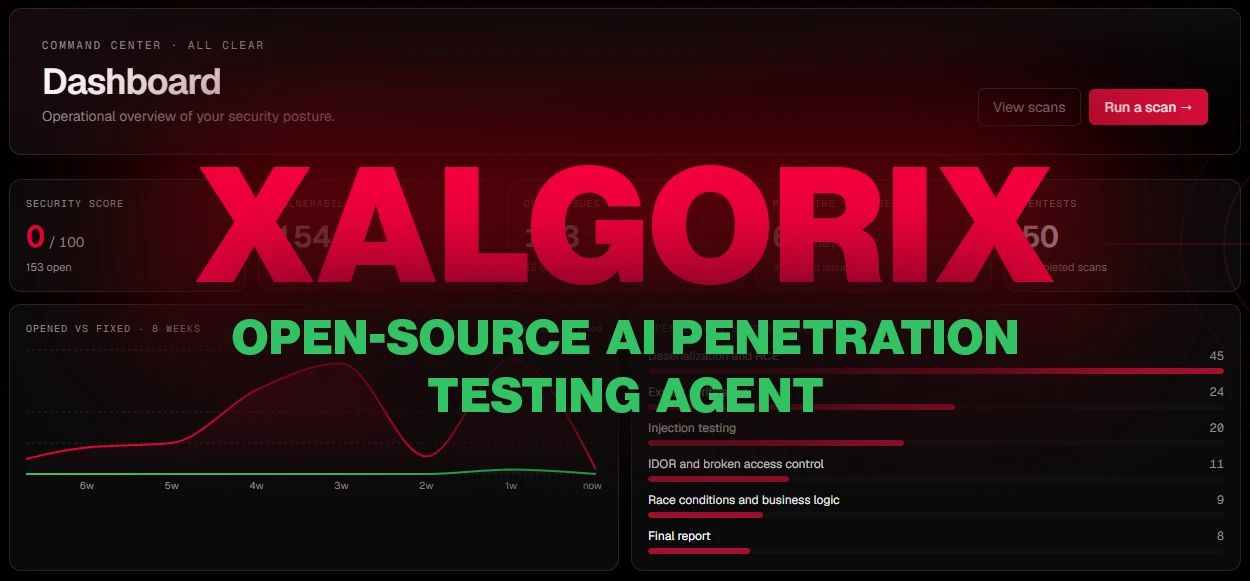
Xalgorix, an open-source AI penetration testing tool, employs a dual-agent system to verify vulnerabilities before reporting them, aiming to reduce false positives in security assessments.
Xalgorix is a new open-source penetration testing tool that intelligently verifies vulnerabilities before flagging them. The tool uses a two-agent system where the primary agent identifies potential bugs, and a secondary verifier must confirm the bugs' legitimacy. If the verifier cannot validate the finding, it is flagged for manual review, ensuring that only credible vulnerabilities are reported.
The verification process involves a 22-phase test plan that includes reconnaissance and culminates in a final report. Xalgorix utilizes various standard tools like Nmap, Nuclei, and SQLmap while working with multiple large language model (LLM) providers. A scope guard feature prevents the tool from making calls to any hosts outside its configured targets, enhancing security during testing.
Penetration testing tools like Xalgorix are designed to identify vulnerabilities in systems by simulating attacks. These tools often automate the process of scanning for weaknesses, which can include anything from misconfigurations to exploitable code. By employing advanced verification methods, tools like Xalgorix aim to improve the accuracy of vulnerability reporting, ensuring that security teams can focus on real threats rather than false alarms.
The tool is expected to benefit organizations conducting regular security assessments, particularly those concerned with the accuracy of vulnerability findings. By minimizing false positives, Xalgorix allows security professionals to allocate their resources more effectively, focusing on genuine security risks. The tool is currently in the early stages of deployment, and its effectiveness in real-world scenarios remains to be fully evaluated.
Xalgorix was released recently, and while its internal testing has shown promising results, the timeline for widespread adoption is still unclear. The development team has conducted tests with known vulnerabilities, including real CVEs, to validate the tool’s performance against patched versions. However, specific metrics and benchmarks from these tests have not yet been published.
Krishna Kumar, the founder of the project, has indicated that the team has begun working on validation benchmarks, known as XBOW, but has not completed all tests. They have not yet planned to release benchmark results, which leaves the community eager for more information on the tool's efficacy. As the project evolves, the community is watching closely for updates on performance and potential improvements.
Current unknowns include the specific performance metrics of Xalgorix and its comparative effectiveness against established tools like Nuclei and OWASP ZAP. The project's team has not disclosed detailed test results or a timeline for future updates, which leaves security professionals curious about the tool's reliability and its potential impact on penetration testing practices.