Critical Apache Roller RCE Flaw Under Active Exploitation, No Authentication Required
A critical vulnerability in Apache Roller allows unauthenticated remote code execution, with active exploitation reported.
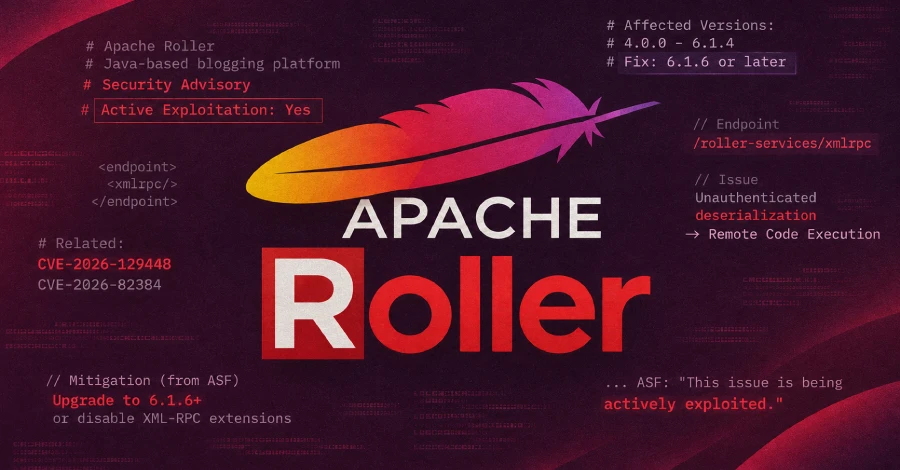
A serious security vulnerability in Apache Roller, an open-source blogging platform, is currently being exploited without requiring authentication, according to the Apache Software Foundation (ASF).
The vulnerability, identified as CVE-2026-129448, has a CVSS score of 9.8 and is categorized as an unauthenticated deserialization issue in the XML-RPC endpoint. This flaw enables remote attackers to execute arbitrary code on affected systems. ASF confirmed that the issue is being actively exploited in the wild, though it did not provide specifics on the nature of these attacks or the targets involved.
The flaw arises from the XML-RPC endpoint's handling of vendor extension types, allowing it to process these types without prior authentication of the requester. This design oversight means that attackers can send specially crafted requests to the endpoint, leading to potential remote code execution. The vulnerability is similar to another issue tracked as CVE-2026-82384, which was patched in September 2026, affecting only Apache Roller version 6.1.5.
Apache Roller is a Java-based blogging platform that utilizes XML-RPC, a protocol that allows remote procedure calls over HTTP. In this context, XML-RPC endpoints enable external applications to interact with the platform, but if not properly secured, they can become entry points for malicious actors. The deserialization flaw specifically allows attackers to manipulate data structures, potentially executing harmful commands on the server.
The affected versions include Apache Roller from 4.0.0 to 6.1.4. Users of these versions are at risk, especially if they have not implemented security measures or updates. ASF has not disclosed the scale of the exploitation or specific targets, leaving organizations using these versions vulnerable to attacks.
The vulnerability was first reported by security researcher n0mi1k, with Matt Raible also credited for bringing it to attention. Following the discovery, ASF has advised users to upgrade to Apache Roller version 6.1.6 or later, which disables the vulnerable extension types and blocks XML-RPC requests when the feature is turned off.
As of now, it is unclear how widespread the exploitation is and whether specific industries or organizations are being targeted. Observers should monitor for updates from ASF regarding the ongoing situation and any further recommendations for securing Apache Roller installations.
What security teams should do
- Upgrade to Apache Roller version 6.1.6 or later.
- Set 'enabledForExtensions' to 'false' in WEB-INF/web.xml if immediate patching is not feasible.
- Remove the '/roller-services/xmlrpc' servlet mapping and restart Roller.
What it meansA critical flaw in Apache Roller allows remote code execution without authentication, posing significant risks to users of affected versions.
Ask your IT team this weekWhich versions of Apache Roller are currently in use within our organization?What steps have we taken to secure our XML-RPC endpoints?
DecisionThe IT team will upgrade to the latest version of Apache Roller, and security will verify completion.