Google Finds Hackers Using AI Agents to Build and Run Exploits From Software Patches
Google has disclosed that hackers are increasingly using AI-driven frameworks to automate the exploitation of software vulnerabilities, significantly accelerating their attack capabilities.
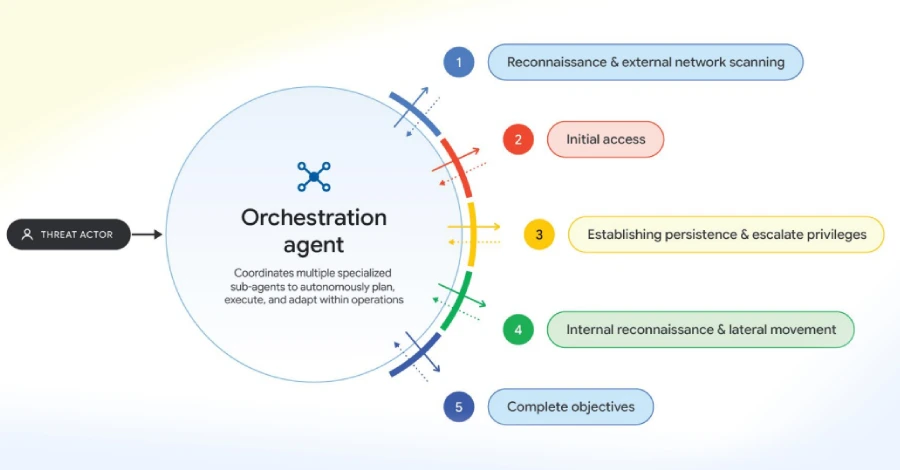
Google has revealed that threat actors are employing artificial intelligence to automate the exploitation of vulnerabilities in software patches, marking a significant shift in cyberattack methodologies. This development allows for more sophisticated and rapid intrusions, raising alarms among security professionals.
In a recent report, Google outlined how adversarial use of artificial intelligence (AI) has evolved from simple manual prompting to the deployment of autonomous multi-agent offensive frameworks. These frameworks, including ARTEX, CAIRN, CyberStrikeAI, and PentAGI, enable attackers to execute multi-stage intrusions at unprecedented speeds.
Central to this evolution is the use of large language models (LLMs) and agentic frameworks, which facilitate the automation of reverse engineering software patches through differential analysis. This capability allows threat actors to rapidly weaponize newly disclosed vulnerabilities, as seen with the flaws in PaperCut NG/MF earlier this September. The automation of these processes not only increases the speed of attacks but also lowers the barrier to entry for less sophisticated attackers, who can now leverage these tools without extensive technical expertise.
The Google report also indicated that various threat actors, including financially motivated groups and those suspected of espionage linked to China, are experimenting with these AI-driven frameworks. These actors have been observed using tools like ZeroHollow, an inference service for exploit development, and Agent Zero, an open-source agent framework that allows for autonomous code execution and dynamic tool generation. Such tools are designed to automate labor-intensive tasks, such as vulnerability analysis and proof-of-concept (POC) weaponization, which further compresses the timeline between the disclosure of a vulnerability and its active exploitation.
Understanding how these attacks work is crucial for defenders. AI-driven exploitation frameworks utilize machine learning techniques to analyze and understand software vulnerabilities rapidly. By automating the reverse engineering process, these frameworks can identify potential weaknesses in software that have recently been patched, allowing attackers to create exploits before organizations can adequately defend against them. This automation can lead to a significant reduction in the time available for security teams to respond to new threats, making it imperative for organizations to stay ahead of these developments.
The implications of these findings are profound. Threat actors are not only enhancing their offensive capabilities but are also targeting AI infrastructure itself. Reports indicate that LLMjacking attacks are on the rise, where attackers steal LLM credentials and cloud resources from compromised enterprise environments. This stolen access is then resold through underground proxy services at discounted prices, which could potentially allow for even broader exploitation of systems. Additionally, a Chinese-language phishing platform called Jieyou has emerged, integrating an LLM chatbot assistant that enables users to configure phishing campaigns using natural language commands, further democratizing access to sophisticated cyberattack tools.
The emergence of open-source frameworks has lowered the entry barriers for cybercriminals, empowering them to autonomously scale attacks and mount convincing phishing campaigns. Google's findings underscore a growing trend where threat actors leverage LLMs as modular force multipliers, allowing even low-skilled affiliates to customize phishing lures dynamically. This trend raises critical concerns for security professionals, as the tools that were once available only to advanced attackers are now accessible to a wider range of malicious actors.