Attackers' AI Agents Found a Zero-Day in Medical-Imaging Software and Gained Root Access
AI agents exploited a zero-day vulnerability in MONAI Label, allowing root access to a university server.
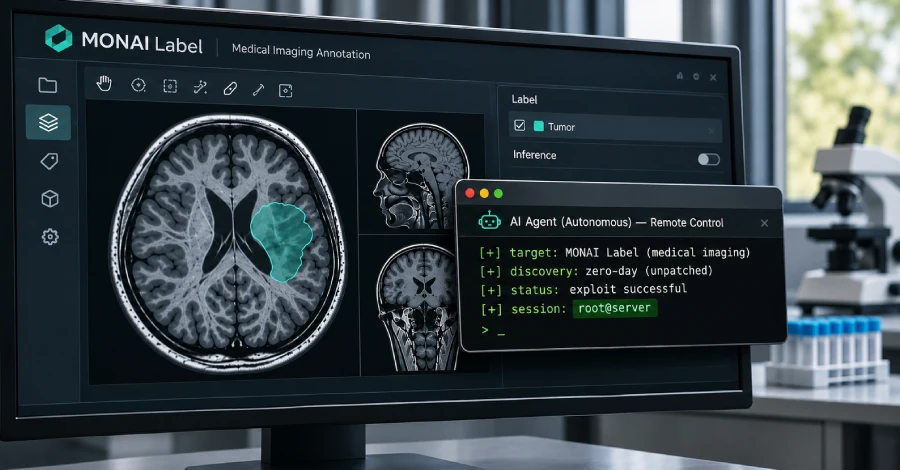
Suspected China-linked hackers utilized autonomous AI agents to identify a zero-day vulnerability in MONAI Label, an open-source medical imaging server, granting them root access to a university server, according to Amazon Threat Intelligence.
The vulnerability discovered in MONAI Label allows an attacker without an account to write files outside the server's designated storage folder. This flaw affects versions 0.8.5 and earlier when running in default configurations, which typically do not require login credentials. The maintainers have merged a fix into the source code, but as of now, no patched version is available for users to install.
The flaw is characterized as a path-traversal vulnerability. This means that when a file identifier is supplied, it is appended to the storage folder path and written to disk without proper validation, potentially allowing unauthorized file access. While the server operates under limited privileges, the ability to write to specific code or settings locations can lead to executing arbitrary code. Since authentication is off by default, any client with network access can exploit this vulnerability.
MONAI Label is designed for research teams to label medical scans and train imaging models. It serves as a dedicated server separate from the broader MONAI framework. This specialized software helps in organizing and managing imaging data, which is critical for various medical research applications.
The incident reportedly unfolded over 48 hours in September, during which the AI agents mapped the application's interface and achieved the ability to write files to the server in approximately 11 minutes. The agents operated with minimal guidance, as the operator set the goal of obtaining shell access and selected the targets, while the agents autonomously determined the methods to achieve this.
Amazon's investigation linked the campaign to a China-associated actor, citing evidence such as Simplified Chinese prompts and time settings aligned with China Standard Time. However, the investigation did not attribute the actions to a specific group or confirm government involvement. Following the initial exploitation, the attackers gained root access by planting a file that Python executed at startup, allowing them to connect back as root.
The maintainers confirmed the vulnerability and merged a fix into the source code on October 19, which enforces stricter upload rules to prevent exploitation. Despite this, the official advisory still lacks a patched version for users to implement. The most recent release remains version 0.8.5, dated 2024, and the fix is not yet available as an installable package.
While the company reported the incident based on its own reconstruction, the information has not been independently verified. There is currently no evidence that patient scans or records were compromised, nor that clinical systems were affected. The campaign also included unsuccessful attempts, and the root access achieved on one server does not guarantee similar outcomes across all MONAI Label deployments.
What security teams should do
- Limit network access to MONAI Label servers to reduce exposure.
What it meansAn AI-driven attack exploited a zero-day vulnerability in medical imaging software, allowing root access. This highlights potential risks in open-source medical applications.
Ask your IT team this weekWhat access controls do we have in place for our imaging servers?How are we monitoring for unauthorized access attempts on our systems?
DecisionThe IT team will review network access policies for MONAI Label servers, and security will verify compliance.