Unpatched Cacti Zero-Day Enables RCE in Just Four HTTP Requests via Guest Access
A new zero-day vulnerability in Cacti enables remote code execution through guest access, exposing sensitive data and network systems.
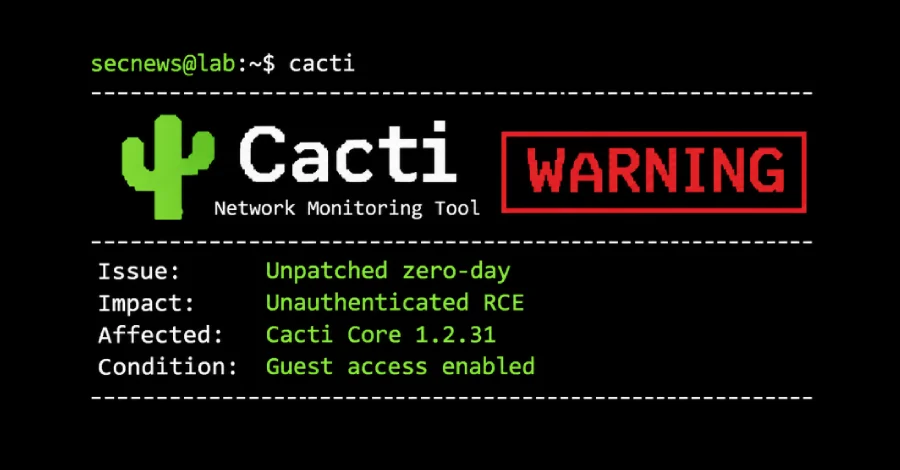
A recently discovered zero-day vulnerability in Cacti, an open-source network monitoring tool, allows for remote code execution via guest access, raising significant security concerns for users. The exploit, tracked as 4HTTP2SHELL and 4HTTP2ROOT, can be executed with just four HTTP requests, without requiring authentication or a valid API key.
The vulnerability affects Cacti Core version 1.2.31, the latest release, when the guest account is enabled. A security researcher known as 'ek0ms savi0r' demonstrated that an attacker could exploit this flaw to execute arbitrary commands as the Cacti server user. The attack does not require login credentials or phishing attempts, making it particularly dangerous.
The exploitation process involves manipulating a configuration setting called 'preview_graphs_per_page' through the 'auth_profile.php?action=update_data' endpoint. This setting is intended to control the number of graphs displayed in Preview Mode. By injecting non-numeric text into this parameter, an attacker can trigger a second-order SQL injection, which allows for arbitrary SQL query execution when the graph preview page is accessed.
SQL injection is a type of attack where an attacker inserts or 'injects' SQL code into a query. This can manipulate databases in unintended ways, such as retrieving sensitive data or executing administrative operations. In this case, the attacker can modify records in Cacti's poller table, which is crucial for monitoring network devices.
Successful exploitation of this vulnerability can give an attacker control over the Cacti server, providing a gateway into the broader network. As Cacti often stores sensitive information like credentials for various network devices, this access can lead to further compromises beyond the monitoring server.
The researcher identified four key failures in the Cacti software that enable this exploit. In the absence of a patch, security experts recommend disabling the guest account and limiting access to the Cacti web interface. Users should also review their poller configuration entries to check for any unauthorized command values.
As of now, there is no assigned CVE identifier for this vulnerability, and a timeline for a fix has not been provided.
What security teams should do
- Disable the guest account in Cacti immediately.
- Restrict access to the Cacti web interface to authorized users only.
- Review poller configuration entries for unexpected command values.
What it meansA zero-day vulnerability in Cacti allows remote code execution through guest access, which can compromise sensitive data and network controls.
Ask your IT team this weekWhich systems currently have the guest account enabled in Cacti?What measures are in place to monitor unauthorized access to Cacti?
DecisionThe IT team disables the guest account in Cacti, and security checks that it was done.