Hackers Exploit Two GeoServer Flaws as Researchers Warn of Unauthenticated RCE Chains
Active exploitation of two newly patched GeoServer vulnerabilities raises concerns for organizations using the platform.
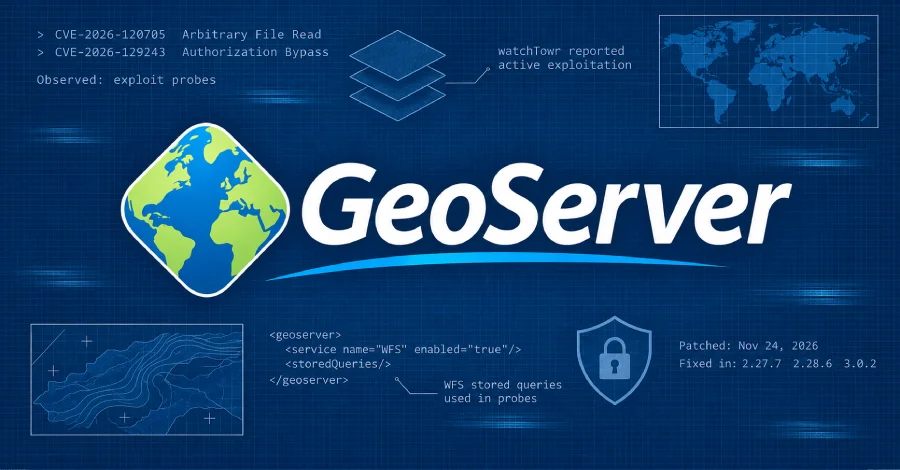
Threat actors are exploiting two recently patched security flaws in GeoServer, prompting warnings from researchers about potential remote code execution chains. The vulnerabilities were disclosed on November 24, 2026, and organizations are advised to update their systems immediately.
Two newly discovered vulnerabilities in GeoServer are currently being exploited by attackers, according to threat intelligence firm watchTowr. The vulnerabilities, identified as CVE-2026-120705 and CVE-2026-129243, were publicly disclosed on November 24, 2026. The flaws enable attackers to execute remote code, posing a serious risk to organizations using the platform. The exploitation attempts reportedly began shortly after the vulnerabilities were made known, indicating a swift reaction from malicious actors.
The first vulnerability, CVE-2026-120705, has been linked to the ability to generate and invoke stored queries, which attackers can leverage to verify server vulnerabilities. In conjunction with other weaknesses in GeoServer, this flaw can potentially create a chain of unauthenticated remote code execution. The second vulnerability, CVE-2026-129243, is part of a more complex five-step process that attackers can exploit, allowing them to gain administrative access under certain conditions.
GeoServer is an open-source server designed to facilitate the sharing and editing of geospatial data. It supports various data formats and is commonly used in geographic information systems (GIS). The vulnerabilities in question arise from SQL injection flaws that can be exploited to execute arbitrary code on the server. Attackers can manipulate SQL queries sent to the database, potentially leading to unauthorized access and control over the server's operations.
Organizations utilizing GeoServer are at risk due to these vulnerabilities, especially if they have not yet updated to the latest versions. The recent history of GeoServer includes multiple security flaws, with the latest ones appearing just months after another critical vulnerability was exploited in the wild. This pattern suggests that attackers are increasingly targeting GeoServer installations, raising concerns about the security of geospatial data.
The timeline of events indicates that the vulnerabilities were disclosed in November 2026, with active exploitation attempts observed shortly thereafter. The previous critical vulnerability, CVE-2026-76904, was also subject to exploitation and had a high severity rating, highlighting a concerning trend in the security of GeoServer.
GeoServer maintainers have released updated versions 2.27.7, 2.28.6, and 3.0.2 to address the vulnerabilities. Security researchers, including those from Eye Security and Rapid7, have played a crucial role in identifying and reporting these flaws. The project maintainers have acknowledged the need for immediate updates and have provided guidance on mitigating risks associated with the vulnerabilities.
Despite the availability of patches, there are still unknowns regarding the full extent of exploitation and whether all affected systems have been secured. Organizations are advised to closely monitor their GeoServer instances and implement the latest updates to protect against potential attacks. Continued vigilance is necessary as attackers may evolve their tactics in response to the patching efforts.
What security teams should do
- Organizations should apply the latest GeoServer updates to versions 2.27.7, 2.28.6, and 3.0.2.
- Monitor for any signs of exploitation attempts targeting GeoServer.
What it meansTwo newly patched vulnerabilities in GeoServer are being actively exploited, which could lead to unauthorized access and control of systems using the platform.
Ask your IT team this weekWhich versions of GeoServer are currently deployed in our environment?What measures are in place to restrict access to our GeoServer instances?
DecisionThe IT team will ensure all GeoServer instances are updated to the latest versions, and security will verify compliance.