North Korea-Linked PolinRider Poisons Over 7,600 GitHub Repositories to Spread Malware
North Korean threat actors have compromised over 7,600 GitHub repositories to distribute malware via a Python loader.
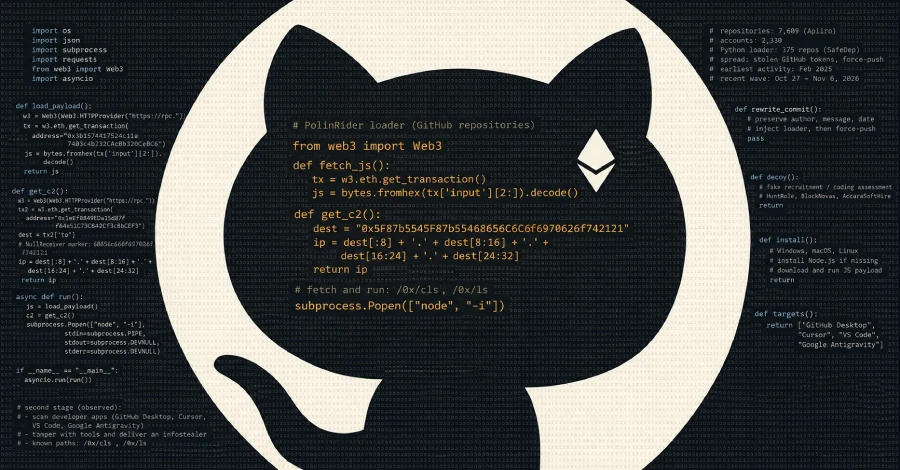
The PolinRider campaign, linked to North Korean threat actors, has been found to have infected over 7,600 GitHub repositories with a malicious Python loader, enabling the spread of malware across numerous developer environments.
The PolinRider campaign has been observed injecting a Python loader into GitHub repositories, with evidence suggesting that this activity began as early as February 2025. SafeDep reported that the loader typically hides within a small utilities package or in the conftest.py file. When Python imports the file, the loader reads the latest transaction from an Ethereum wallet, decodes the input data as JavaScript, and executes it using Node.js.
The JavaScript code then locates a command-and-control (C2) server by reading a secondary wallet. It subsequently hands off the next stage of execution to a detached interactive Node.js environment. SafeDep identified the loader in 375 public repositories associated with 260 accounts, although there is no evidence that it has been distributed through PyPI or npm.
The PolinRider loader retrieves an encrypted second-stage Node.js payload that scans for installed developer applications such as GitHub Desktop and VS Code. It modifies these tools to execute attacker-controlled code and deliver infostealer malware. This campaign operates alongside a longer-running initiative known as Contagious Interview, which focuses on compromising developer systems through social engineering.
Malicious campaigns like PolinRider leverage open-source software registries as a means of initial access into corporate environments. By compromising a single maintainer account, threat actors can transform open-source dependencies into widespread distribution channels for malware. This approach allows attackers to exploit vulnerabilities in the software supply chain.
Recent findings indicate that the repositories infected by PolinRider include notable victims such as Neutralinojs and InstaWP Connect. The loader was pushed to 2,040 repositories between October 27 and November 6, 2026. Research from Apiiro estimates that PolinRider has been detected in at least 7,609 GitHub repositories owned by 2,330 accounts, primarily targeting developers.
The attack's timeline shows that in May 2025, PolinRider targeted nine packages using hijacked maintainer accounts to deploy poisoned versions in a rapid timeframe. This earlier attack utilized EtherHiding to retrieve a JavaScript downloader, which was then used to deliver various malware payloads.
Currently, it remains unclear how many organizations have been affected overall and the full extent of the malware's impact. Observations suggest that the infection may have persisted undetected for an extended period, with the potential for further propagation as the campaign continues.
What security teams should do
- Security teams should audit GitHub repositories for unauthorized changes.
- Organizations must review their security protocols for access to maintainer accounts.
What it meansNorth Korean actors have compromised numerous GitHub repositories to distribute malware, which poses risks to software supply chains.
Ask your IT team this weekHow many of our repositories have been recently modified?What measures are in place to secure maintainer accounts?
DecisionThe IT team reviews repository access logs, and security checks that the review was completed.